

Carrito de compra
Su pedido cuenta con 0 productos
Envío gratis a partir de $389.00 (Consulta T&C)
| ISBN: | 9781461483823 |
|---|---|
| Formato: | ePub |
| Idioma: | Inglés |
| Editorial: | Springer Nature |
| Tema: | Psicología |
| Subtema: | Neuropsicología |
| Año de publicación: | 2013-09-24 |
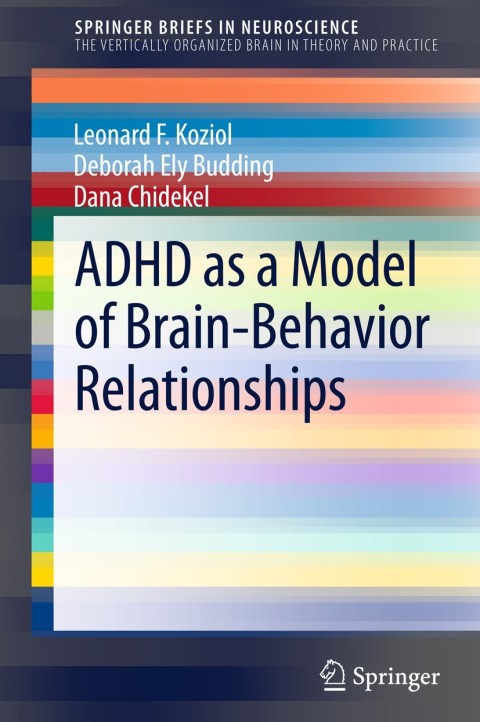
ADHD as a Model of Brain-Behavior Relationships Leonard F. Koziol, Deborah Ely Budding, and Dana Chidekel  Series Title: Springer Briefs in Neuroscience Subseries: The Vertically Organized Brain in Theory and Practice Its been a basic neurological given: the brain does our thinking, and has evolved to do the thinking, as controlled by the neocortex. In this schema, all dysfunction can be traced to problems in the brain lateral interactions. But in scientific reality, is this really true? Challenging this traditional cortico-centric view is a body of research emphasizing the role of the structures that control movement-the brains vertical organization-in behavioral symptoms. Using a well-known, widely studied disorder as a test case, ADHD as a Model of Brain-Behavior Relationships offers an innovative framework for integrating neuroscience and behavioral research to refine diagnostic process and advance the understanding of disorders. Identifying a profound disconnect between current neuropsychological testing and the way the brain actually functions, this revision of the paradigm critiques the DSM and ICD in terms of the connectedness of brain structures regarding cognition and behavior. The authors argue for a large-scale brain network approach to pathology instead of the localizing that is so common historically, and for an alternate set of diagnostic criteria proposed by the NIMH. Included in the coverage: The diagnosis of ADHD: history and context. ADHD and neuropsychological nomenclature Research Domain Criteria: a dimensional approach to evaluating disorder The development of motor skills, executive function, and a relation to ADHD The role of the cerebellum in cognition, emotion, motivation, and dysfunction How large-scale brain networks interact Heralding a more accurate future of assessment, diagnosis, and treatment of neurodevelopmentaldisorders, ADHD as a Model of Brain-Behavior Relationships represents a major step forward for neuropsychologists, child psychologists, and psychiatrists, or any related profession interested in a neuroscientific understanding of brain function.  ​










 Este sitio web utiliza cookies para mejorar la experiencia del usuario y asegurar su funcionamiento con eficacia.
Al utilizarlo usted acepta el uso de cookies.
Este sitio web utiliza cookies para mejorar la experiencia del usuario y asegurar su funcionamiento con eficacia.
Al utilizarlo usted acepta el uso de cookies.