

Carrito de compra
Su pedido cuenta con 0 productos
Envío gratis a partir de $389.00 (Consulta T&C)
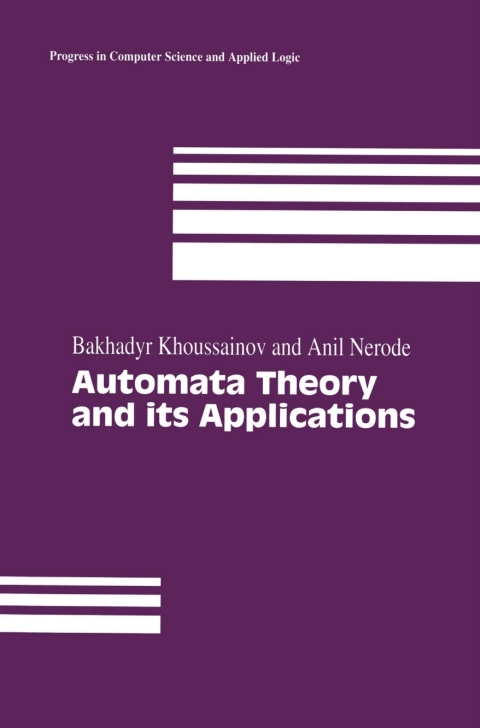
| ISBN: | 9781461201717 |
|---|---|
| Formato: | Page Fidelity |
| Idioma: | Inglés |
| Editorial: | Springer Nature |
| Tema: | Matemáticas |
| Subtema: | Lógica |
| Año de publicación: | 2012-12-06 |
The theory of finite automata on finite stings, infinite strings, and trees has had a dis tinguished history. First, automata were introduced to represent idealized switching circuits augmented by unit delays. This was the period of Shannon, McCullouch and Pitts, and Howard Aiken, ending about 1950. Then in the 1950s there was the work of Kleene on representable events, of Myhill and Nerode on finite coset congruence relations on strings, of Rabin and Scott on power set automata. In the 1960s, there was the work of Btichi on automata on infinite strings and the second order theory of one successor, then Rabins 1968 result on automata on infinite trees and the second order theory of two successors. The latter was a mystery until the introduction of forgetful determinacy games by Gurevich and Harrington in 1982. Each of these developments has successful and prospective applications in computer science. They should all be part of every computer scientists toolbox. Suppose that we take a computer scientists point of view. One can think of finite automata as the mathematical representation of programs that run us ing fixed finite resources. Then Btichis SIS can be thought of as a theory of programs which run forever (like operating systems or banking systems) and are deterministic. Finally, Rabins S2S is a theory of programs which run forever and are nondeterministic. Indeed many questions of verification can be decided in the decidable theories of these automata.








 Este sitio web utiliza cookies para mejorar la experiencia del usuario y asegurar su funcionamiento con eficacia.
Al utilizarlo usted acepta el uso de cookies.
Este sitio web utiliza cookies para mejorar la experiencia del usuario y asegurar su funcionamiento con eficacia.
Al utilizarlo usted acepta el uso de cookies.