
Carrito de compra
Su pedido cuenta con 0 productos
Envío gratis a partir de $389.00 (Consulta T&C)
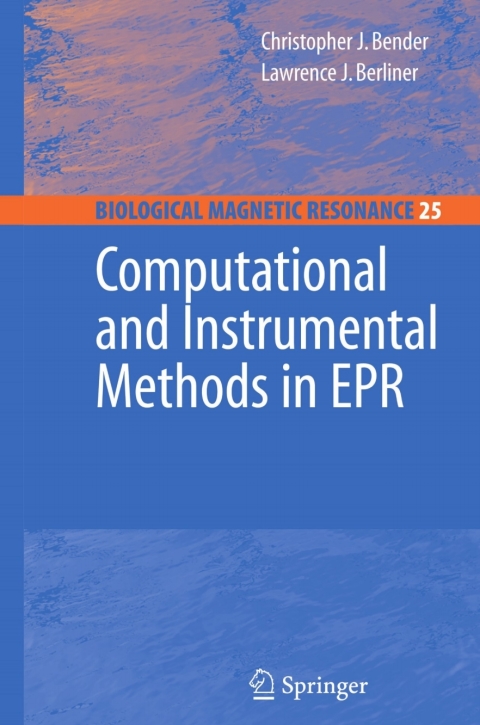
| ISBN: | 9780387388809 |
|---|---|
| Formato: | Page Fidelity |
| Idioma: | Inglés |
| Editorial: | Springer Nature |
| Tema: | Ciencia |
| Subtema: | Ciencias de la Vida biofísica |
| Año de publicación: | 2007-12-27 |
Electron magnetic resonance in the time domain has been greatly facilitated by the introduction of novel resonance structures and better computational tools, such as the increasingly widespread use of density-matrix formalism. This second v- ume in our series, devoted both to instrumentation and computation, addresses - plications and advances in the analysis of spin relaxation time measurements. Chapters 1 deals with the important problem of measuring spin relaxation times over a broad temporal range. The author, Dr. Sushil Misra, has worked on a wide variety of solutions to problems in this area, with respect to both experimental and theoretical aspects, and Chapter 1 summarizes much of his recent work, which was enhanced by a fruitful collaboration with the late Professor Jacques Pescia. Chapter 2 presents solutions to the problem of measuring short spin relaxation times. Again, in collaboration and tribute to the late Jacques Pescias laboratory, part of the chapter represents a translation of the amplitude modulation technique section from a doctoral thesis by Robert Lopez in 1993 to The Paul Sabatier U- versity. Experimental data that appeared in the original thesis are placed at the end of subsections that correspond to the described technique. Chapter 3 takes up the problem of multi-frequency ENDOR and ESEEM, and illustrates how small stepwise increments of spectrometer operating parameters can enable one to better determine spin-Hamiltonian parameters via a graphical analysis.








 Este sitio web utiliza cookies para mejorar la experiencia del usuario y asegurar su funcionamiento con eficacia.
Al utilizarlo usted acepta el uso de cookies.
Este sitio web utiliza cookies para mejorar la experiencia del usuario y asegurar su funcionamiento con eficacia.
Al utilizarlo usted acepta el uso de cookies.