
Carrito de compra
Su pedido cuenta con 0 productos
Envío gratis a partir de $389.00 (Consulta T&C)
| ISBN: | 9781402066115 |
|---|---|
| Formato: | Page Fidelity |
| Idioma: | Inglés |
| Editorial: | Springer Nature |
| Tema: | Ciencias sociales |
| Subtema: | Demografía |
| Año de publicación: | 2008-03-08 |
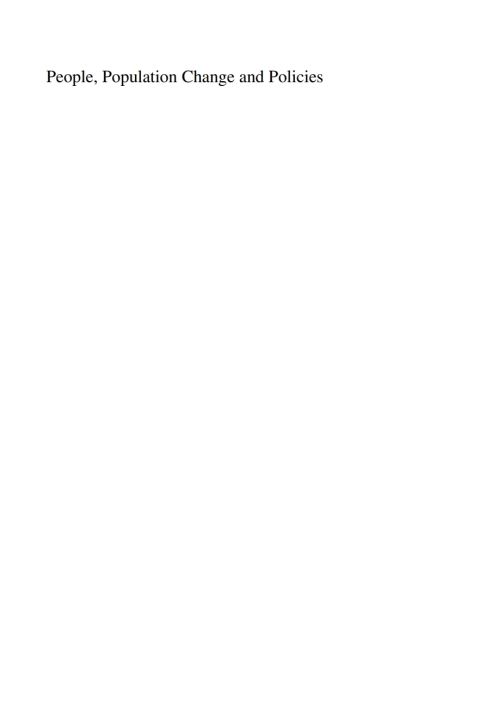
European countries, including the DIALOG countries, have faced a major de- graphic change and transition in the last thirty years. They are experiencing lo- term downward trends in fertility, leading to demographic ageing. Fertility rates are now below replacement level in nearly all countries. As a result, natural p- ulation growth rates are starting to decline, or population sizes are falling o- right. At the same time, the proportion of elderly dependants continues to grow while the working-age population declines in absolute and relative terms (see Kontula and Miettinen 2005). Moreover, net immigration, which potentially could offset declines in working-age population, remains generally low in most European countries (Grant et al. 2004). There are a great number of societal problems that arise from this demographic transition. The International Monetary Fund (2004) argues that the impact of - coming demographic changes on economical growth could be substantial. The h- toric association between demographicand macro-economicvariablessuggests that the projected increase in elderly dependency ratios and the projected decline in the share of the working-age population could result in slower per capita GDP growth, and lower saving and investment (IMF 2004, 147). For example, the estimates s- gest that demographic change could reduce annual real per capita GDP growth in 1 1 advanced countries by an average of / % point by 2050, i. e. , growth would be / % 2 2 point lower than if the demographic structure had remained the same as in 2000 (IMF 2004, 147).







 Este sitio web utiliza cookies para mejorar la experiencia del usuario y asegurar su funcionamiento con eficacia.
Al utilizarlo usted acepta el uso de cookies.
Este sitio web utiliza cookies para mejorar la experiencia del usuario y asegurar su funcionamiento con eficacia.
Al utilizarlo usted acepta el uso de cookies.