
Carrito de compra
Su pedido cuenta con 0 productos
Envío gratis a partir de $389.00 (Consulta T&C)
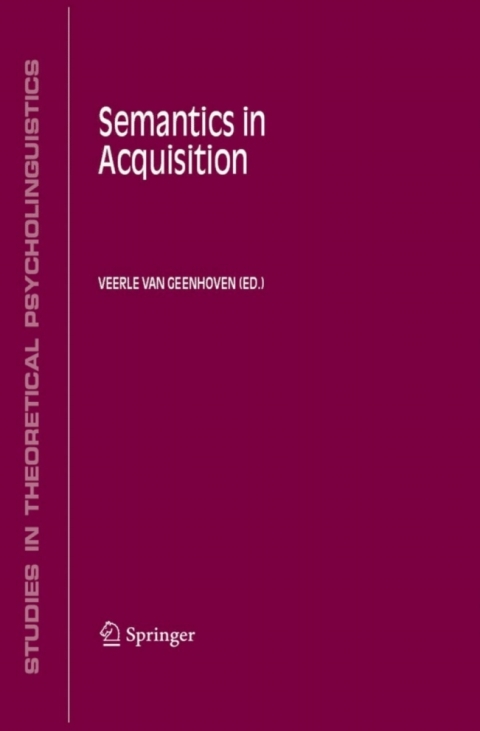
| ISBN: | 9781402044854 |
|---|---|
| Formato: | Page Fidelity |
| Idioma: | Inglés |
| Editorial: | Springer Nature |
| Tema: | Lenguas |
| Subtema: | Lingüística histórica y comparada |
| Año de publicación: | 2006-07-15 |
A good deal of work in language acquisition has been devoted to children interpretation of sentences that contain the universal quantifier, e. g. , every in English. It has been observed in several experimental studies and across several languages that some school-age children experience difficulty in interpreting such sentences (e. g. , Inhelder & Piaget, 1964; Roeper & de Villiers, 1991; Philip, 1995). Non-adult responses from children have been found in various conditions, including the circumstance exemplified in the picture in Figure 1, where three boys are each riding an elephant and a fourth elephant (referred to as the ‘extra-object’) is not being ridden. Some children who are shown such a picture sometimes respond No to the question in (1) relative to this picture: (1) Is every boy riding an elephant? Figure 1. The Extra-Object Condition To justify their negative answer to the question in (1), children often point to the extra object, i. e. , the elephant that is not being ridden. This reply has been called the symmetrical response or the exhaustive pairing response since children who give this kind of response seem to interpret the question to be about the symmetry (i. e. , one-to-one relation) between the set of entities denoted by the subject noun (the boys) and the set denoted by the object noun (the elephants).





 Este sitio web utiliza cookies para mejorar la experiencia del usuario y asegurar su funcionamiento con eficacia.
Al utilizarlo usted acepta el uso de cookies.
Este sitio web utiliza cookies para mejorar la experiencia del usuario y asegurar su funcionamiento con eficacia.
Al utilizarlo usted acepta el uso de cookies.