
Carrito de compra
Su pedido cuenta con 0 productos
Envío gratis a partir de $389.00 (Consulta T&C)
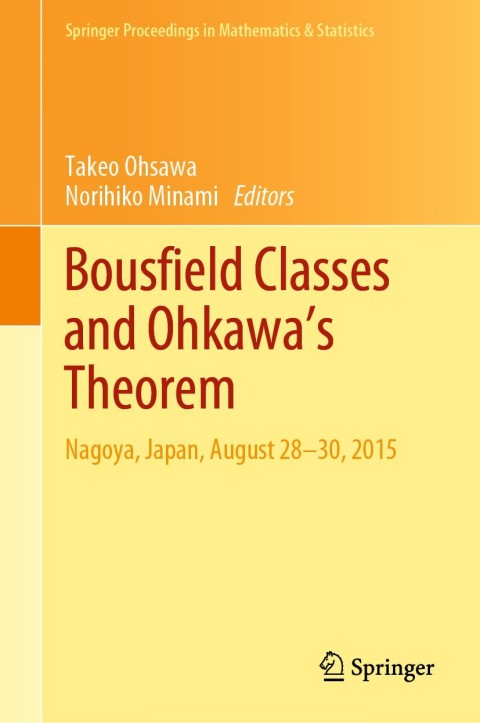
| ISBN: | 9789811515880 |
|---|---|
| Formato: | ePub |
| Idioma: | Inglés |
| Editorial: | Springer Nature |
| Tema: | Matemáticas |
| Subtema: | Topología |
| Año de publicación: | 2020-03-18 |
This volume originated in the workshop held at Nagoya University, August 28–30, 2015, focusing on the surprising and mysterious Ohkawas theorem: the Bousfield classes in the stable homotopy category SH form a set. An inspiring, extensive mathematical story can be narrated starting with Ohkawas theorem, evolving naturally with a chain of motivational questions:  Ohkawas theorem states that the Bousfield classes of the stable homotopy category SH surprisingly forms a set, which is still very mysterious. Are there any toy models where analogous Bousfield classes form a set with a clear meaning? The fundamental theorem of Hopkins, Neeman, Thomason, and others states that the analogue of the Bousfield classes in the derived category of quasi-coherent sheaves Dqc(X) form a set with a clear algebro-geometric description. However, Hopkins was actually motivated not by Ohkawas theorem but by his own theorem with Smith in the triangulated subcategory SHc, consisting of compact objects in SH. Now the following questions naturally occur: (1) Having theorems of Ohkawa and Hopkins-Smith in SH, are there analogues for the Morel-Voevodsky A1-stable homotopy category SH(k), which subsumes SH when k is a subfield of C?, (2) Was it not natural for Hopkins to have considered Dqc(X)c instead of Dqc(X)? However, whereas there is a conceptually simple algebro-geometrical interpretation Dqc(X)c = Dperf(X), it is its close relative Dbcoh(X) that traditionally, ever since Oka and Cartan, has been intensively studied because of its rich geometric and physical information. This book contains developments for the rest of the story and much more, including the chromatics homotopy theory, which the Hopkins–Smith theorem is based upon, and applications of Luries higher algebra, all by distinguished contributors.








 Este sitio web utiliza cookies para mejorar la experiencia del usuario y asegurar su funcionamiento con eficacia.
Al utilizarlo usted acepta el uso de cookies.
Este sitio web utiliza cookies para mejorar la experiencia del usuario y asegurar su funcionamiento con eficacia.
Al utilizarlo usted acepta el uso de cookies.