

Carrito de compra
Su pedido cuenta con 0 productos
Envío gratis a partir de $389.00 (Consulta T&C)
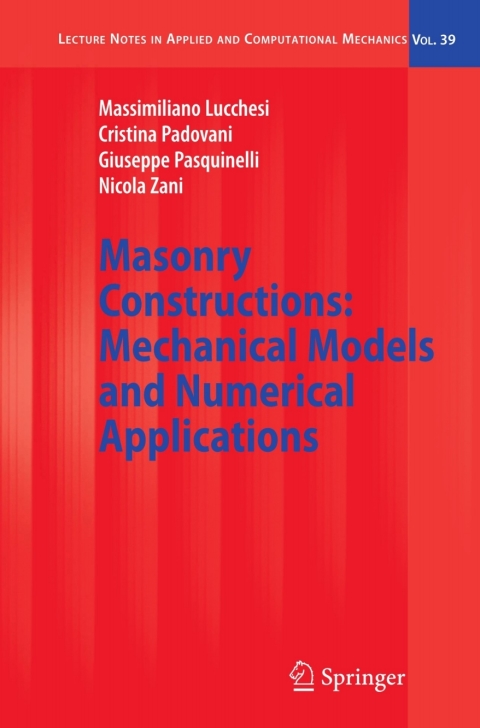
| ISBN: | 9783540791119 |
|---|---|
| Formato: | Page Fidelity |
| Idioma: | Inglés |
| Editorial: | Springer Nature |
| Tema: | Tecnología e ingeniería |
| Subtema: | Mecánica |
| Año de publicación: | 2008-05-13 |
Many historically and artistically important masonry buildings of the world architecturalheritageareindireneedofmaintenanceandrestoration.Inorder tooptimizesuchoperationsintermsofcost-e?ectiveness,architecturalimpact andstatice?ectiveness,accuratemodelsofthestructuralbehaviorofmasonry constructions are invaluable. The ultimate aim of such modeling is to obtain important information, such as the stress ?eld, and to estimate the extent of cracking and its evolution when the structure is subjected to variations in both boundary and loading conditions. Although masonry has been used in building for centuries, it is only - centlythatconstitutivemodelsandcalculationtechniqueshavebeenavailable that enable realistic description of the static behavior of structures made of this heterogeneous material whose response to tension is fundamentally d- ferent from that to compression. Important insights on the mechanical behavior of masonry arches and vaults come from as far back as Leonardo [10], Hooke [58], Poleni [92] and many other authors (see [47], [9] and [10] for detailed references). Castigliano, in his famous paper on the Mosca bridge [23], and Signorini, in his studies on masonry beams [97], [98], showed both the possibility and necessity of taking into account the weak tensile strength of masonry material.









 Este sitio web utiliza cookies para mejorar la experiencia del usuario y asegurar su funcionamiento con eficacia.
Al utilizarlo usted acepta el uso de cookies.
Este sitio web utiliza cookies para mejorar la experiencia del usuario y asegurar su funcionamiento con eficacia.
Al utilizarlo usted acepta el uso de cookies.