
Carrito de compra
Su pedido cuenta con 0 productos
Envío gratis a partir de $389.00 (Consulta T&C)
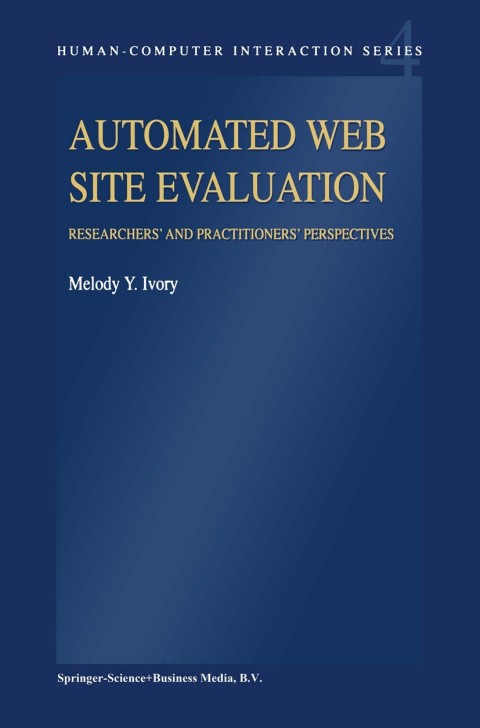
| ISBN: | 9789401703758 |
|---|---|
| Formato: | ePub |
| Idioma: | Inglés |
| Editorial: | Springer Nature |
| Tema: | Computadoras |
| Subtema: | Interfaces de usuarios |
| Año de publicación: | 2013-06-29 |
Among all information systems that are nowadays available, web sites are definitely the ones having the widest potential audience and the most significant impact on the everyday life of people. Web sites contribute largely to the information society: they provide visitors with a large array of services and information and allow them to perform various tasks without prior assumptions about their computer literacy. Web sites are assumed to be accessible and usable to the widest possible audience. Consequently, usability has been recognized as a critical success factor for web sites of every kind. Beyond this universal recognition, usability still remains a notion that is hard to grasp. Summative evaluation methods have been introduced to identify potential usability problems to assess the quality of web sites. However, summative evaluation remains limited in impact as it does not necessarily deliver constructive comments to web site designers and developers on how to solve the usability problems. Formative evaluation methods have been introduced to address this issue. Evaluation remains a process that is hard to drive and perform, while its potential impact is probably maximal for the benefit of the final user. This complexity is exacerbated when web sites are very large, potentially up to several hundreds of thousands of pages, thus leading to a situation where eval uating the web site is almost impossible to conduct manually. Therefore, many attempts have been made to support evaluation with: ? Models that capture some characteristics of the web site of interest.










 Este sitio web utiliza cookies para mejorar la experiencia del usuario y asegurar su funcionamiento con eficacia.
Al utilizarlo usted acepta el uso de cookies.
Este sitio web utiliza cookies para mejorar la experiencia del usuario y asegurar su funcionamiento con eficacia.
Al utilizarlo usted acepta el uso de cookies.