
Carrito de compra
Su pedido cuenta con 0 productos
Envío gratis a partir de $389.00 (Consulta T&C)
| ISBN: | 9781461472889 |
|---|---|
| Formato: | ePub |
| Idioma: | Inglés |
| Editorial: | Springer Nature |
| Tema: | Ciencia |
| Subtema: | Astronomia |
| Año de publicación: | 2013-05-14 |
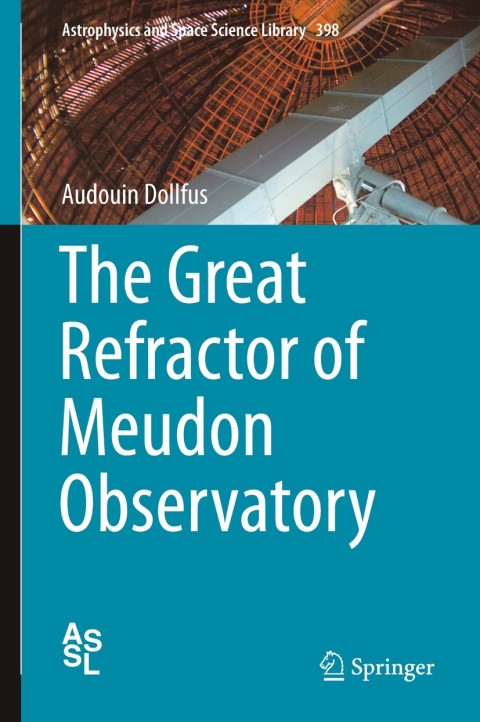
The large telescope at Meudon has become legendary. When it was conceived, after 1870, astronomy as a whole was limited to visual observation. Knowledge of the sky was limited to what one could see, assisted only by optical means. The large telescopes produced at this time produced larger images, permitting close-up views: the Meudon telescope was able to accomplish this perfectly.  At Meudon, which became the Mecca of visual observation, the major planets were examined in a way that no other telescope had previously been able to. The telescope monitored the state of their atmospheres and mapped the appearance of their surfaces. Through the telescope, one could obtain photographs showing the nuclei of comets, revealing their very small size, and by using an eyepiece one could measure the separation of double stars. With a marvellous little instrument, the polarimeter, the nature of clouds in planetary atmospheres has been determined, and the type of surface material identified. Many more results were obtained, while photography, universally adopted, revolutionized other knowledge about the world. The sensitive emulsion, combined with large aperture reflecting telescopes, revealed the deepness and richness of the cosmos. The vast telescope of Meudon, which was the largest refracting telescope in Europe, became a legendary instrument and was symbolic of a new way to practice astronomy.  Audouin Dollfus, a renowned astronomer, describes the great years of the Meudon telescope. He gives us the entire story of this instrument, from the birth of the concept that drove Jules Janssen at the end of the nineteenth century, to the idea that French astronomy could provide an outstanding telescope which would approach the limits of technical and industrial resources. The telescope remained unchanged until 2006, when the first steps toward restoration and public reopening were taken.






 Este sitio web utiliza cookies para mejorar la experiencia del usuario y asegurar su funcionamiento con eficacia.
Al utilizarlo usted acepta el uso de cookies.
Este sitio web utiliza cookies para mejorar la experiencia del usuario y asegurar su funcionamiento con eficacia.
Al utilizarlo usted acepta el uso de cookies.