

Carrito de compra
Su pedido cuenta con 0 productos
Envío gratis a partir de $389.00 (Consulta T&C)
| ISBN: | 9781643312439 |
|---|---|
| Formato: | ePub |
| Idioma: | Inglés |
| Editorial: | Wiley Global Research (STMS) |
| Tema: | Tecnología e ingeniería |
| Subtema: | Automatización |
| Año de publicación: | 2024-04-01 |
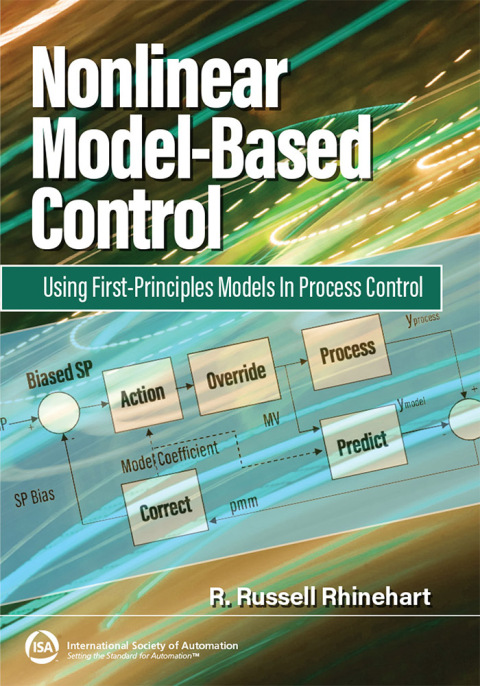
Nonlinear Model-Based Control: Using First-Principles Models in Process Control First-principles models (engineering models) are used in industry for process design, troubleshooting, training, online analysis and supervisory optimization. The authors vision is to use them for control. Why? They effectively handle nonlinearity, nonstationary behavior and interacting variables with just one tuning coefficient per controlled variable (CV). Using optimization, the controller can handle constraints and shape the manipulated variables to achieve desired controlled variable trajectories. Using first-principles models for control can also enhance the operational staffs understanding of the process, support auxiliary process management, and keep the mathematics at the engineers comfort level. In addition, unifying all models across diverse process management operations ensures continuity and compatibility. The book explains four control techniques using first-principles models that have been credibly demonstrated for industrial practice: generic model control, process-model-based control, predictive functional control and horizon predictive control. It illustrates their applications and discusses the pros and cons of each. To provide a better understanding of first-principles models, the book includes examples of setting up functions for controllers and discusses inherent properties such as ease of tuning, the handling of nonlinearity and interaction, feedforward constraints and the range of operation.










 Este sitio web utiliza cookies para mejorar la experiencia del usuario y asegurar su funcionamiento con eficacia.
Al utilizarlo usted acepta el uso de cookies.
Este sitio web utiliza cookies para mejorar la experiencia del usuario y asegurar su funcionamiento con eficacia.
Al utilizarlo usted acepta el uso de cookies.